Marine predators and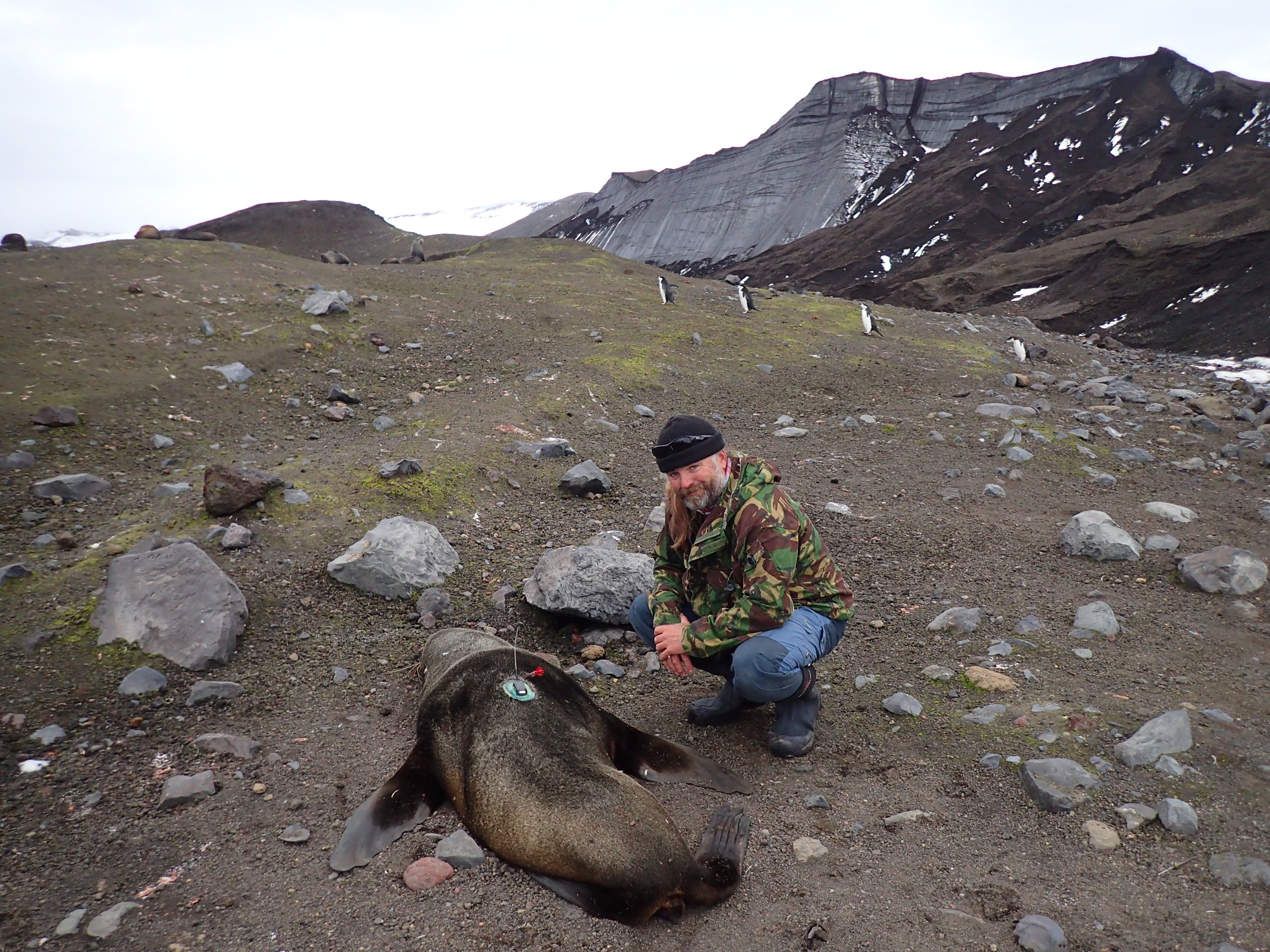 polar regions….no wonder I look so happy 🙂
My name is Andy Lowther, and I am a quantitative ecologist, primarily focussed on marine vertebrates and how they interact with their environment. Broad title, doesnt really say much though…….
To delve a little deeper: my focus is on individual variability in how populations of higher trophic predators ‘go about their job’. Effective conservation management is underpinned by knowing what it is about their environment they like and dont like, and whether that changes between individuals, age classes, sex, other populations and so on. To do THIS, I use a wide range of analytical tools including telemetry, molecular genetics and biogeochemistry. So I dont focus on a technique, I focus on a question and learn the appropriate techniques required to answer them. This has given me a reasonably strong grounding in ecological statistics, ranging from multivariate analyses, linear and additive fixed and mixed effects modelling, state space modelling, Bayesian inference and the like. Hence….QuantEcol (quantitative ecology).
SO not just about counting animals. I am also starting to work actively in linking different scientific fields together to generate a more “regional” approach to ecosystem science. For example, using animal-borne sensor platforms to provide hydrographic data on basal ice sheet melting dynamics to Glaciologists and ice physicists, as well as estimations of sub-surface primary productivity using low-power fluorometers. I am also heavily involved in the scientific aspects of the Commission for the Conservation of Antarctic Marine Living Resources (CCAMLR), where I work primarily on aspects of developing a feedback management system for the krill fishery as well as providing advice on science-based delineation of Marine Protected Areas in the Southern Ocean. Thats just the south – I also work in the High Arctic, in Svalbard.
I landed in northern Norway in February 2013 to come work at the Norwegian Polar Institute. My previous work was in the warmer climes of Adelaide trying to unravel the foraging ecology of Australian sea lions, the only endemic otariid to Australia. It was a particularly entangled ball of string that defied my attempts, raising only more questions. I did however successfully characterise the adult female population structure, determine that adult females forage at the same fine-scale areas repeatedly, and that their pups learn to inhabit adult foraging grounds up to 12 months before they are weaned.
The purpose of this site: twofold really. Firstly, to provide resources and useful info pertaining to the analytical and field techniques I use in my work. Secondly, to bring some of the maritime Antarctic world onto the web. Thirdly to try and communicate what its like moving about as far across the planet as you can, to take up a job. Let me know if I even come close to succeeding on any of these 🙂
 QuantEcol