
The South
- Long-term monitoring of krill-predating pygoscelid penguins at Petermann Island, Antarctica: in collaboration with a good friend and colleague Dr Juan Hofer of the Pontifical Catholic University of Valparaiso, Chile, we have established a Masters degree academic course aiming to give students the tools and experience to conduct field-based marine predator and coastal oceanographic studies, introducing practical skills such as animal handling and biotelemetry tag deployment, using UAV to survey predator population numbers and the statistical skills to assimilate these data into a broader understanding of ecosystem function. The program runs each year and also serves as a long-term monitoring site to provie vital information to CCAMLR to improve our management of the Southern Ocean.
- Antarctica Insync https://www.antarctica-insync.org/ : As part of this international collaborative program, I am leading a project covering three field sites that encompass areas in which the Antarctic krill fishery currently operates, and regions that are proposed to become marine protected areas in which the fishery has never been active. The initiative will last for two field seasons (2026-27 and 2027-28), focussing on the feeding rates of pygoscelid penguins in areas of differing anthropogenic pressure.
- Cetacean bycatch in the Antarctic krill fishery: A sensitive topic, there has been several occurences now of cetaceans (primarily humpback whales) being caught and drowned in trawl fishing nets used by the Antarctic krill fishery. There is a critical need to deploy effective mitigation systems to stop this occuring, and to understand better the behaviour of whales around trawl nets (which is a surprisingly little-studied field). In collaboration with the Norwegian and Chilean krill fishing industry, I am leading a project on trawlers to address this enormous gap in our understanding. Using trawl beam-mounted cameras to record underwater interactions with the net mouth, and UAV surveys of cetacean presence and distribution coupled with photogrammetric estimation of the age classes of whales around the trawlers, our project will provide quantitative evidence on the efficacy of mitigation systems deployed to counter incidental mortalities associated with fishing.
The North
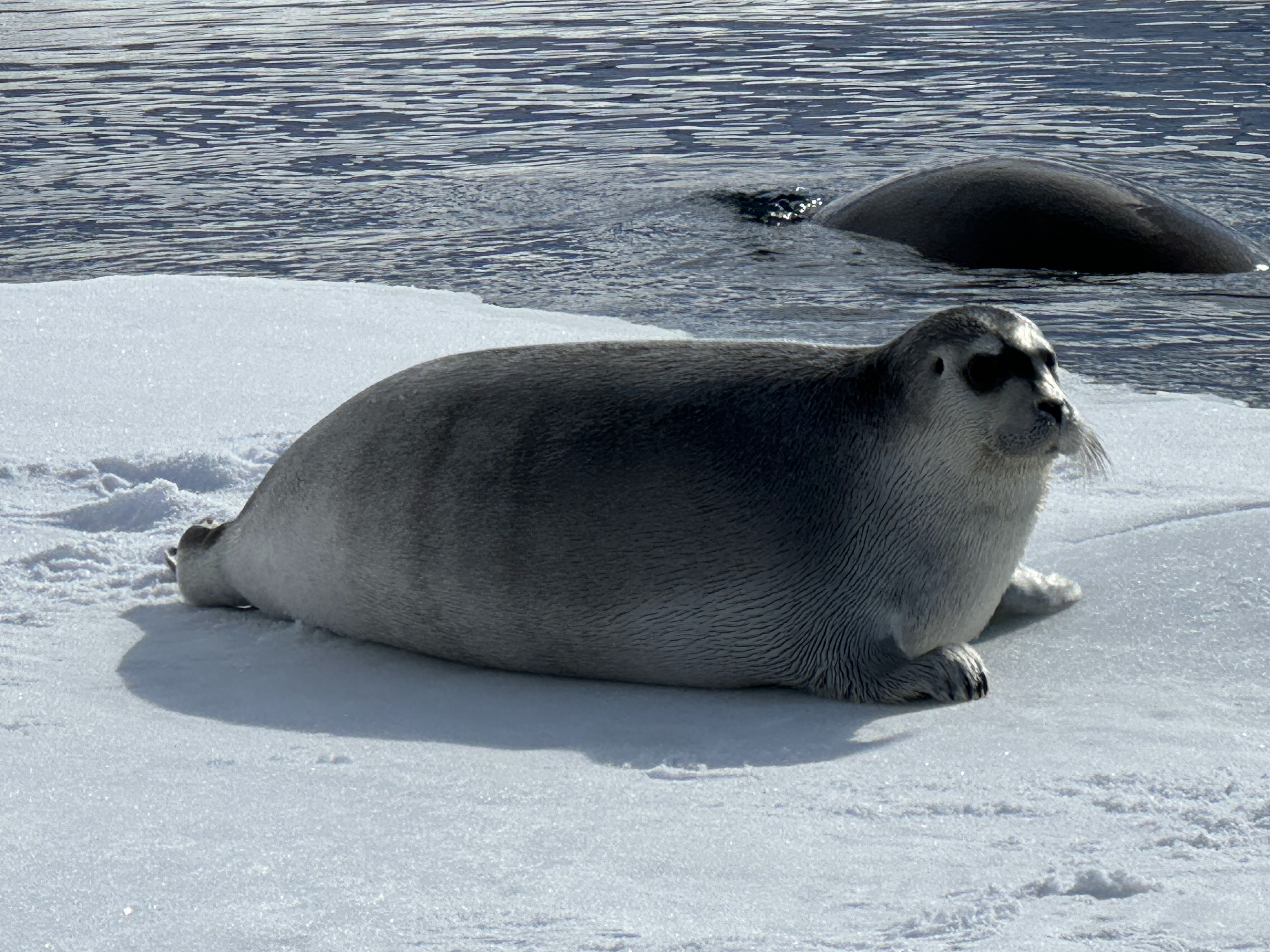
- Population monitoring of ringed seal Pusa hispida along the western Svalbard coastline using VTOL UAV and deep learning
2. The impact of anthropogenic noise on cetaceans in Isfjorden, measured using UAV-deployed high resolution biotelemetry tags
 QuantEcol